Stargazing at La Palma
Canary Islands, Spain. Calculated 24 October 2026 with Astronomy Engine 2.1.19 (MIT licence).
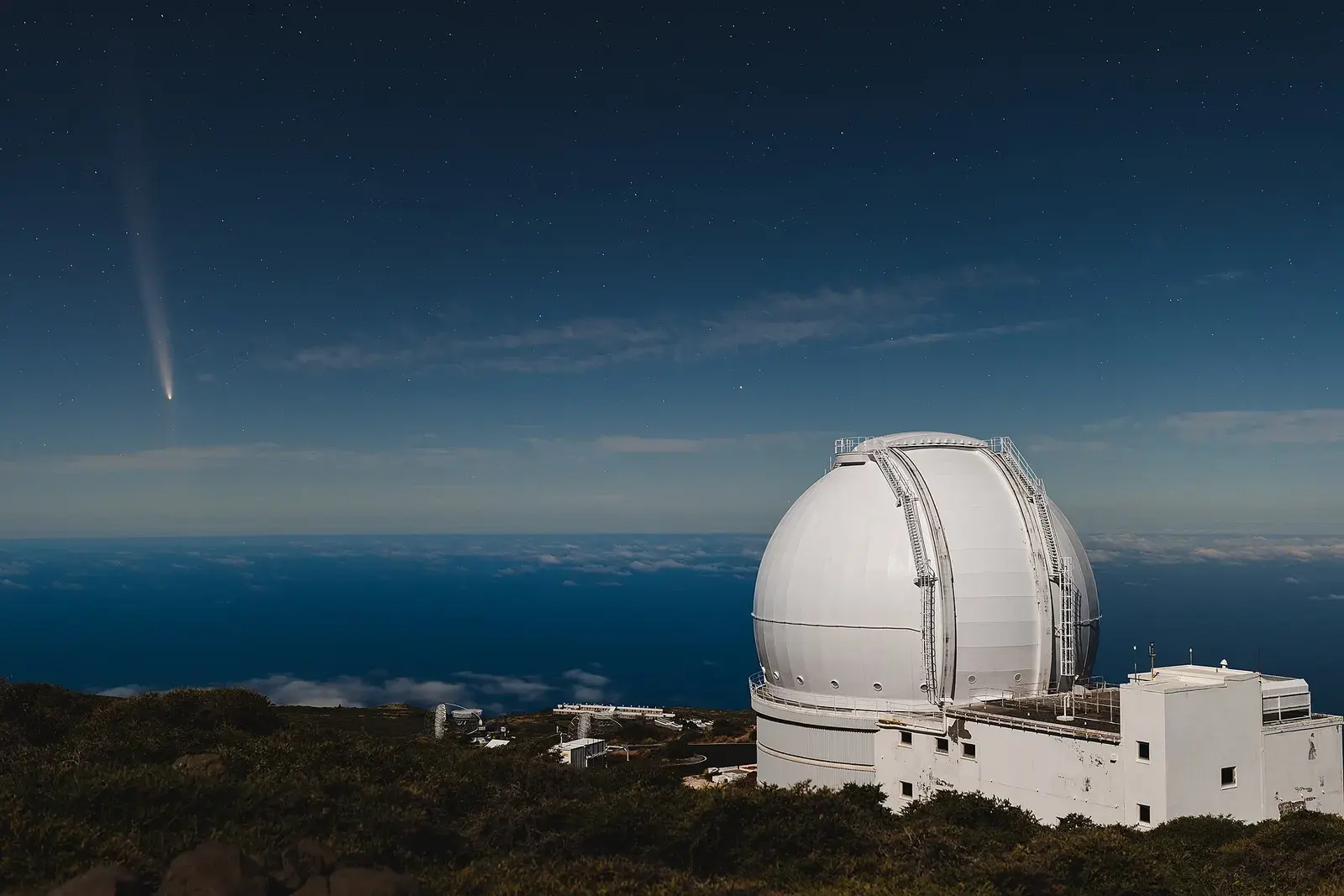
The island of La Palma, home of the Roque de los Muchachos Observatory on its highest ridge.
The darkest weeks ahead
Runs of nights when the Moon is down for almost all of the dark hours. Plan your stay inside one of these.
- 5 Nov to 13 Nov 2026 (9 nights)
- 4 Dec to 12 Dec 2026 (9 nights)
- 3 Jan to 11 Jan 2027 (9 nights)
- 1 Feb to 9 Feb 2027 (9 nights)
- 2 Mar to 11 Mar 2027 (10 nights)
- 1 Apr to 9 Apr 2027 (9 nights)
- 1 May to 8 May 2027 (8 nights)
- 31 May to 7 Jun 2027 (8 nights)
Month by month
| Month | Full darkness | Milky Way centre up |
|---|---|---|
| October 2026 | 9.8 h | 0.5 h |
| November 2026 | 10.3 h | not in the dark hours |
| December 2026 | 10.7 h | not in the dark hours |
| January 2027 | 10.5 h | not in the dark hours |
| February 2027 | 10 h | 0.5 h |
| March 2027 | 9.3 h | 1.8 h |
| April 2027 | 8.2 h | 3.3 h |
| May 2027 | 7.3 h | 4.7 h |
| June 2027 | 6.8 h | 6.7 h |
| July 2027 | 7 h | 5 h |
| August 2027 | 8 h | 3.3 h |
| September 2027 | 9 h | 2 h |
The bright centre of the Milky Way is best here in June. From November to January it is up only in daylight, but the rest of the sky is still worth the trip.
What to know
- The Roque de los Muchachos Observatory stands at about 2,396 m.
- The Canary Islands’ ‘Sky Law’, approved in 1988, limits light pollution to protect the observatories.
- As on Tenerife, low clouds generally stay well below the summit ridge.
The summit road is long and winding. Allow plenty of time, and do not drive it for the first time in the dark if you can avoid it.
Other dark-sky places: Teide National Park, Atacama Desert, NamibRand Nature Reserve, Aoraki Mackenzie. Compare all five.
Sources
- Darkness, Moon and Milky Way: our calculation, Astronomy Engine 2.1.19 (MIT licence). How we worked it out.
- Instituto de Astrofísica de Canarias, observatories leaflet.