Eclipse glasses: how to tell if yours are safe
Last reviewed 24 October 2026.
Looking at the partly covered Sun without proper protection can damage your eyes permanently, and you will not feel it happening. Safe eclipse glasses are cheap and easy to find, but so are fakes. Here is how to tell them apart.
The standard: ISO 12312-2
Eclipse glasses and handheld solar viewers are safe if they meet the international standard ISO 12312-2. The catch, as the American Astronomical Society (AAS) points out, is that a printed claim on the glasses or the packet proves nothing. Anyone can print it, and some sellers have even printed the names of real manufacturers on their own products.
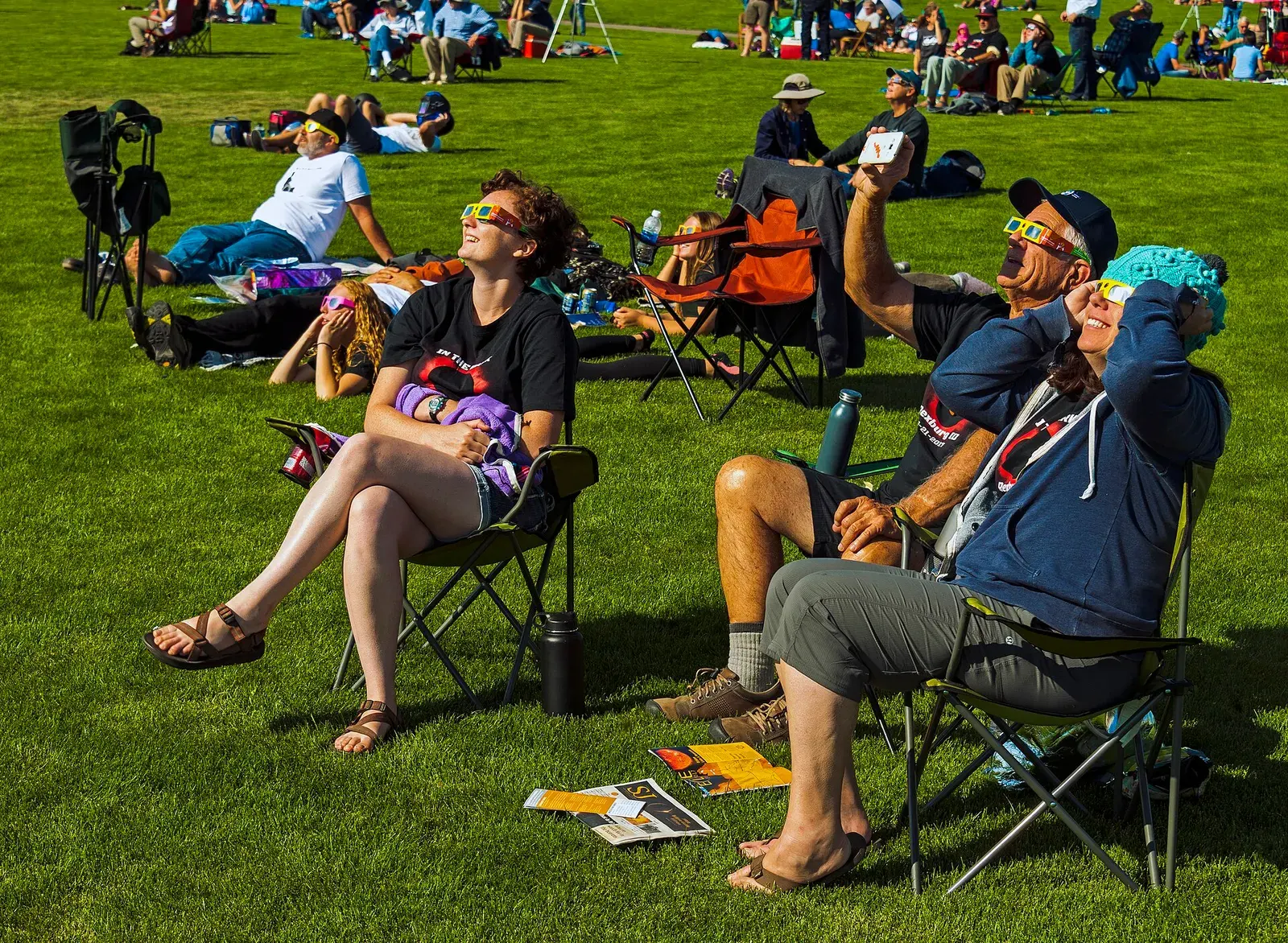
Where to buy
- Buy from a manufacturer on the AAS list of suppliers whose products have passed testing at an accredited laboratory, or from one of their authorised dealers.
- Be wary of glasses found through online ads or search results. The AAS specifically advises against simply searching the internet for them.
- Buy early. Before a big eclipse, demand and fakes both rise.
Three checks at home
These do not replace a laboratory test, but they catch the worst fakes. They are the AAS’s own suggestions.
- Indoors: put them on and look around. You should see nothing at all, except perhaps very bright lights, faintly.
- Outdoors: look around in daylight. Again you should see almost nothing, at most a faint reflection of the Sun from something shiny.
- The Sun: glance at it for under a second. You should see a sharp-edged, round disc on a dark background, not a glow or a haze.
If you are not fully sure of your glasses, the AAS suggests looking for only two or three seconds at a time, every five minutes or so.
When to throw them away
- The filter is torn, scratched or punctured.
- The filter is coming loose from its card or plastic frame.
Never combine them with optics
Do not look through a camera, binoculars or a telescope while wearing eclipse glasses. The optics concentrate the sunlight and will burn straight through. Optics need their own solar filter, fitted securely over the front, not the eyepiece.
Totality is the one exception
During a total eclipse, and only during the minutes when the Sun is completely covered, it is safe to look without glasses. Put them back on the moment any bright Sun reappears. Outside the path of totality, including at 99% coverage, you need them the whole time. Check which places get totality in 2027.
No glasses? Use a pinhole
A pinhole projector is a safe way to watch the partial phases: with your back to the Sun, let sunlight pass through a small hole in a card and look at the image it casts on a surface. A colander or the gaps between leaves work too.
More guides
- How to watch a meteor shower
- How to read an aurora forecast
- Northern lights: where and when it is worth going
- Northern lights tours: what to check before you book
- Stargazing trips: the darkest skies, and when to go
- Planning a trip for the 2027 eclipse
- Smart telescopes: what they can and cannot do
- Every eclipse to 2030, and what your city sees
Sources
- American Astronomical Society, How can you tell if your eclipse glasses or handheld solar viewers are safe?
- NASA, Eclipse safety.